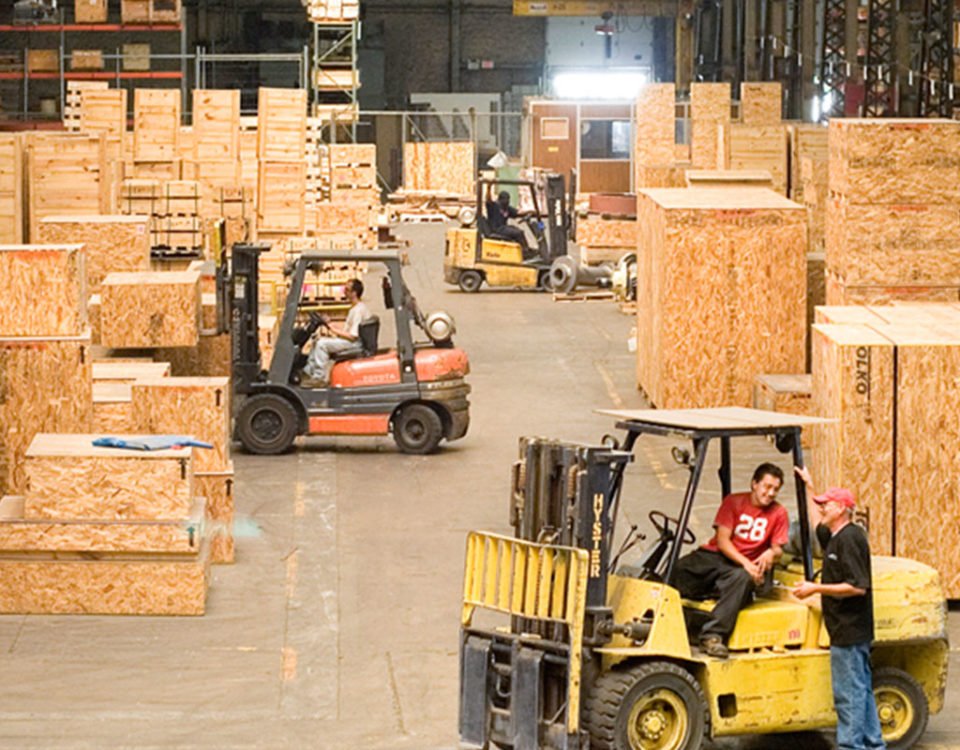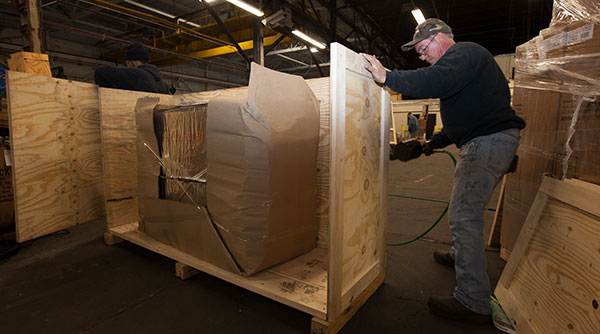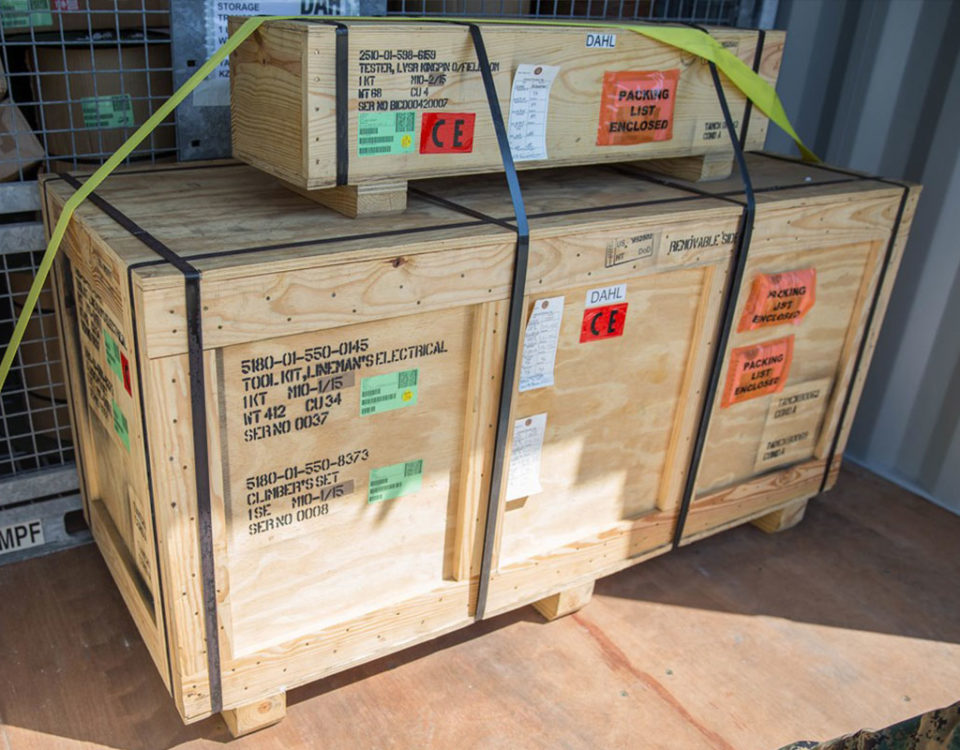


Transloading is the transfer of freight from one mode of transportation or piece of equipment to another, most often from an international ocean container into a domestic 53-foot trailer or railcar. It happens at a warehouse or yard near a port or rail ramp, and shippers use it to lower inland freight costs and container fees.
The savings are real when several containers are headed to the same region, the freight is light for its size, or the load has to split across more than one destination. Heavy, dense or single-destination freight often moves more cheaply by keeping it in the ocean container all the way to the customer.
TL;DR
- Transloading moves freight from one mode or piece of equipment to another, most often from an ocean container into a domestic 53-foot trailer near the port.
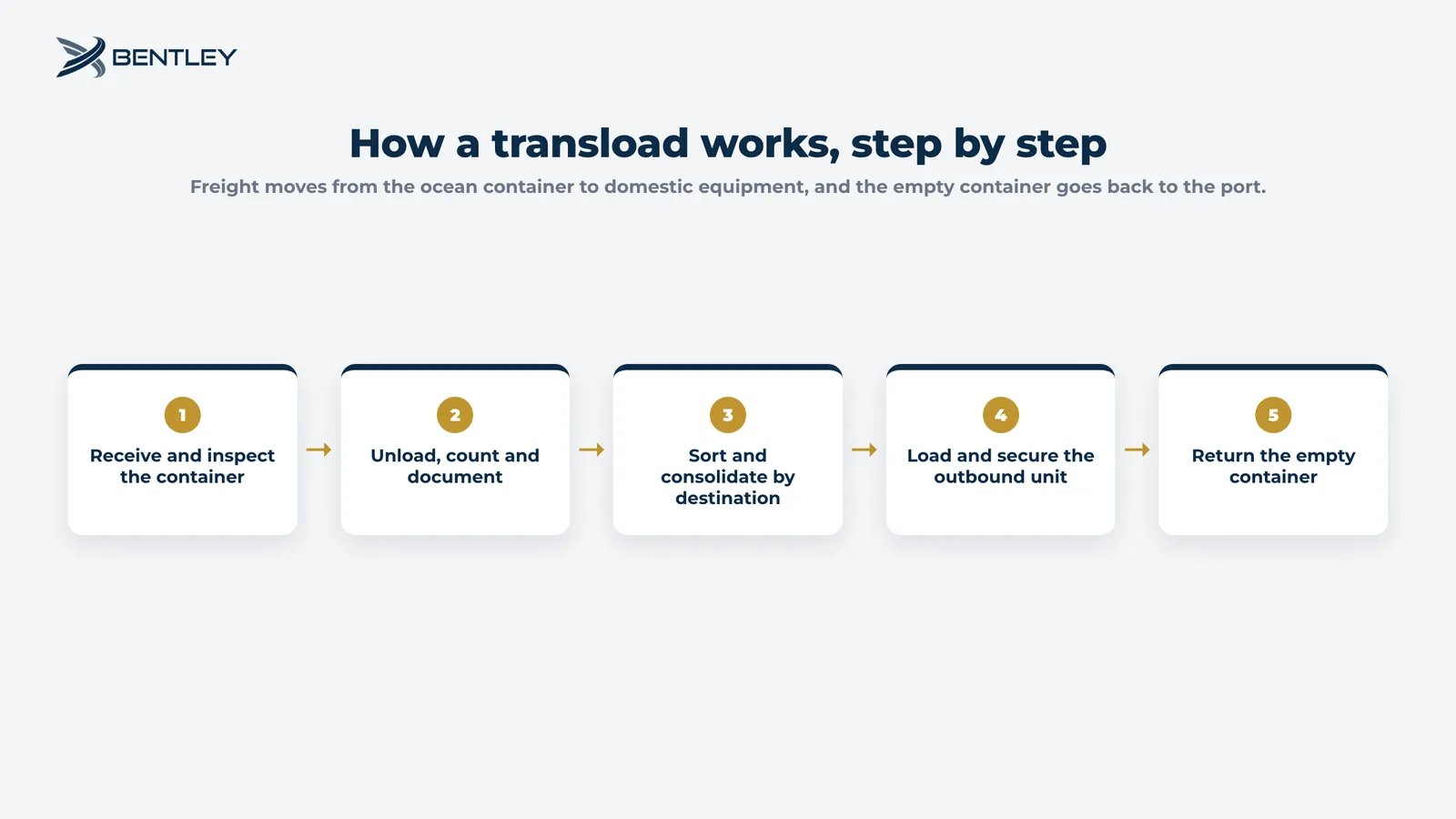
- A transload runs in five steps: receive and inspect, unload and document, sort and consolidate, load and secure, return the empty container.
- The savings come from returning ocean containers before fees build, fitting more freight into each truck, and splitting loads across more than one destination.
- Transloading overlaps with cross-docking, drayage and intermodal, and each one solves a different problem in the inland move.
- Heavy, fragile or single-destination freight often costs less as a direct container move, so price both options before booking the transload.
A container that lands in Baltimore bound for a plant in Ohio usually travels the whole way inland in the same box it crossed the ocean in, because nobody decided otherwise. Call it the default inland move. The shipper pays for the long haul, the chassis under the container, the empty trip back to the port and every day the box sits at a dock waiting to be unloaded.
Transloading replaces that default with a decision. The freight comes out near the port, continues in domestic equipment sized for the job, and the ocean container goes back while the free time is still running.
What is transloading?
Transloading is the process of unloading cargo from one conveyance and reloading it into another so it can continue its trip by a different mode or in different equipment. The most common version in North American import freight moves goods from a 20 or 40 foot ocean container into a 53-foot domestic trailer, but the same term covers several other moves.
Defined Term: Transloading
the transfer of freight from one mode or piece of transport equipment to another, such as ship to truck, rail to truck or truck to rail, with the cargo itself handled and reloaded along the way.
Common transload patterns include:
- Ocean container to domestic trailer. Import freight is unloaded near the port and consolidated into 53-foot dry vans for the inland leg.
- Ocean container to railcar. Freight bound for a long inland haul continues in a domestic boxcar or rail container.
- Railcar to truck. Bulk or palletized freight arriving by rail is transferred to trucks for final delivery to sites without rail access.
- Truck to ocean container. Export freight arrives in domestic trailers and is loaded, blocked and braced into ocean containers or flat racks near the port. This is sometimes called reverse transloading.
Reverse transloading matters most for exporters of machinery and industrial parts. Loading the ocean container near the port keeps the freight in domestic trailers until the last few miles, lets it be staged ahead of the vessel cutoff, and puts the packing, blocking and bracing in the hands of a crew that plans for how the load will ride at sea. Any wood dunnage or blocking that travels in the export container has to meet ISPM-15.
The defining feature is that someone handles the freight. When a sealed container changes from a train to a truck with the freight untouched, that is intermodal shipping, covered in the comparison below.
How does the transloading process work?
A transload runs through five physical steps once the container arrives: receive and inspect, unload and document, sort and consolidate, load and secure, and return the empty container. A sixth step, confirming paperwork and customs status, happens before the container ever leaves the port.
Confirm paperwork and customs status before pickup
Send the transload facility the bill of lading, the packing list, the container number and the outbound delivery plan before the container is picked up. Import freight that has not cleared customs can typically only be unpacked at a facility authorized to handle in-bond cargo, so confirm the customs status first.
Defined Term: Container freight station (CFS)
a facility, often operating under customs bond, where import cargo is unloaded from ocean containers and broken down for delivery, and export cargo is consolidated and loaded into them. Freight still moving in bond is usually handled at a CFS or another bonded site.
Checklist to send ahead of the container:
- Container number, seal number and size (20, 40 or 40 high cube)
- Packing list with piece count, weights and dimensions
- Whether the freight is floor-loaded cartons or palletized
- Outbound destinations and the split of freight across them
- Customs status and any special handling or hazardous material notes
Receive the container and inspect the seal
Check the seal number against the paperwork before the doors open, and photograph the seal, the doors and the first view of the load. A broken or mismatched seal, or visible damage, needs to be recorded before anyone touches the freight, since that record decides who carries a claim later.
Unload, count and document the freight
Unload with the right equipment for the freight: pallet jacks and forklifts for palletized loads, conveyors or hand crews for floor-loaded cartons, and overhead cranes for heavy machinery. Count pieces against the packing list and photograph any damage as it comes off. Floor-loaded containers take far more labor hours to unload than palletized ones, which is often the largest single line in the transload price.
Sort, palletize and consolidate by destination
Group freight by outbound destination, build pallets from loose cartons where the receiving site needs them, and relabel if the next leg calls for it. This is the step where the cube savings happen: freight from several ocean containers is rebuilt into fewer, fuller domestic trailers.
Load and secure the outbound trailer or railcar
Load to the outbound carrier’s weight and axle limits and secure the load for the forces of the new mode. Rail transit puts cargo through coupling impacts and sustained vibration that a short dray never does, so blocking, bracing and dunnage need to be matched to the leg ahead. Record the outbound seal number on the new bill of lading.
Return the empty container
Return the empty ocean container to the terminal or the depot the carrier designates, as early as possible. Every day saved on the return is a day of per diem or detention the shipper does not pay.
Why do shippers use transloading?
Shippers transload to cut three costs: container fees, the number of inland truck moves, and the cost of splitting freight across destinations. It also buys time and flexibility at the port.
Defined Term: Demurrage and detention
charges carriers and terminals bill when a container stays at the terminal (demurrage) or outside it with the shipper (detention, often called per diem) past the free time allowed. Definitions and free-time rules vary by carrier and contract.
The main reasons, in order of how often they drive the decision:
- Return the ocean container fast. Unloading near the port stops the detention or per diem clock days or weeks earlier than a long inland round trip would.
- Fit more freight into each truck. A 53-foot dry van carries roughly 3,800 to 4,000 cubic feet, against roughly 2,700 cubic feet for a 40-foot high cube container, so light freight moves in fewer trucks.
- Split one arrival across several destinations. Freight from one container can be divided among several plants or distribution centers without sending the whole box to each.
- Switch modes for the long haul. Moving freight into domestic rail equipment can lower cost on long inland distances, at the price of more transit time and one more handoff at the far end.
- Hold freight near the port. Short-term storage lets the shipper decide the final destination after arrival, a practice often called postponement.
- Add work on the way through. Relabeling, palletizing, kitting or protective packing can happen during the transload, before the freight reaches the customer.
Worked example: 30 containers of light freight
Thirty 40-foot high cube containers of light, cartoned freight hold roughly 80,000 cubic feet of cargo at about 2,690 cubic feet each. At roughly 3,900 cubic feet per 53-foot trailer, the same freight fits in about 20 or 21 trailers, provided each stays under road weight limits. That removes about nine or ten inland truck moves, and all 30 ocean containers go back to the port empty that week with none of them making the inland round trip. Real results depend on how well the freight stacks and what it weighs.
How is transloading different from cross-docking, drayage and intermodal?
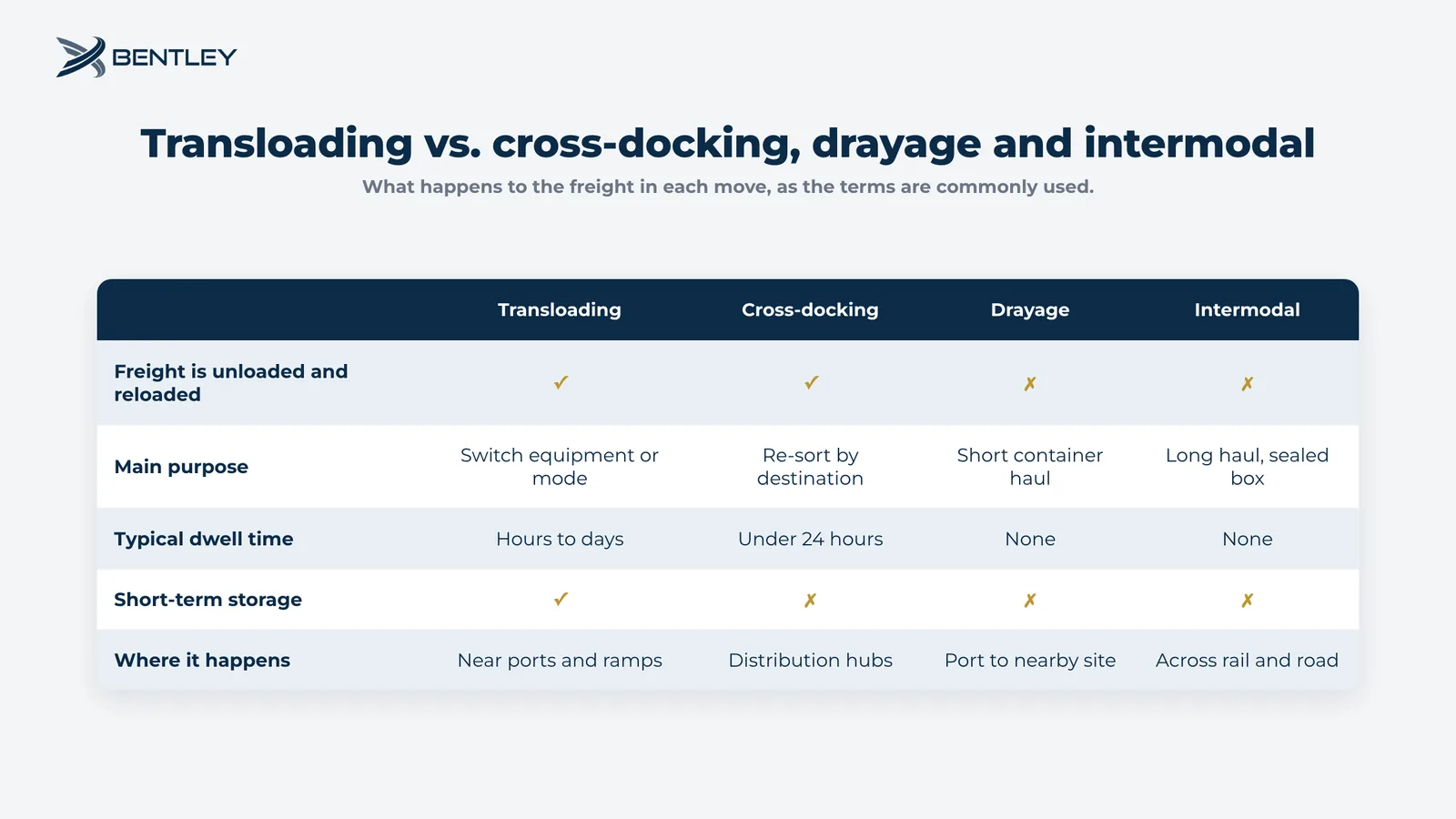
Transloading is the only one of these moves that both handles the freight and changes the equipment it rides in. Cross-docking also handles the freight, drayage and intermodal keep it sealed in the container, and warehousing holds it for longer.
| Move | What happens to the freight | Typical dwell time | Use it when |
|---|---|---|---|
| Transloading | Unloaded from one conveyance and reloaded into another, often a different mode | Hours to a few days | Freight should continue in different equipment, such as domestic trailers or railcars |
| Cross-docking | Unloaded, sorted by destination and reloaded outbound, usually trailer to trailer | Under 24 hours | Mixed inbound loads need re-sorting for many outbound destinations |
| Drayage | Stays in the container for a short truck haul | None | A container needs to reach a nearby warehouse, rail ramp or customer |
| Intermodal | Stays sealed while the container itself moves between rail and road | None | A long-distance move where the box can stay closed |
| Transshipment | Stays in the container while it moves between vessels at a hub port | Varies with vessel schedules | The ocean route requires an intermediate stop |
| Warehousing | Received, stored and picked to order over time | Weeks to months | Inventory needs to be held close to customers or the port |
Defined Term: Drayage
the short-distance trucking of a container between a port or rail ramp and a nearby facility, usually on a chassis. A transload almost always includes a drayage leg from the terminal to the transload site.
The lines blur in practice. A transload facility may cross-dock part of a load the same day and store the rest, and most transloads begin and end with a drayage move. What matters for cost is which of these moves the freight actually needs.
What kinds of cargo are good candidates for transloading?
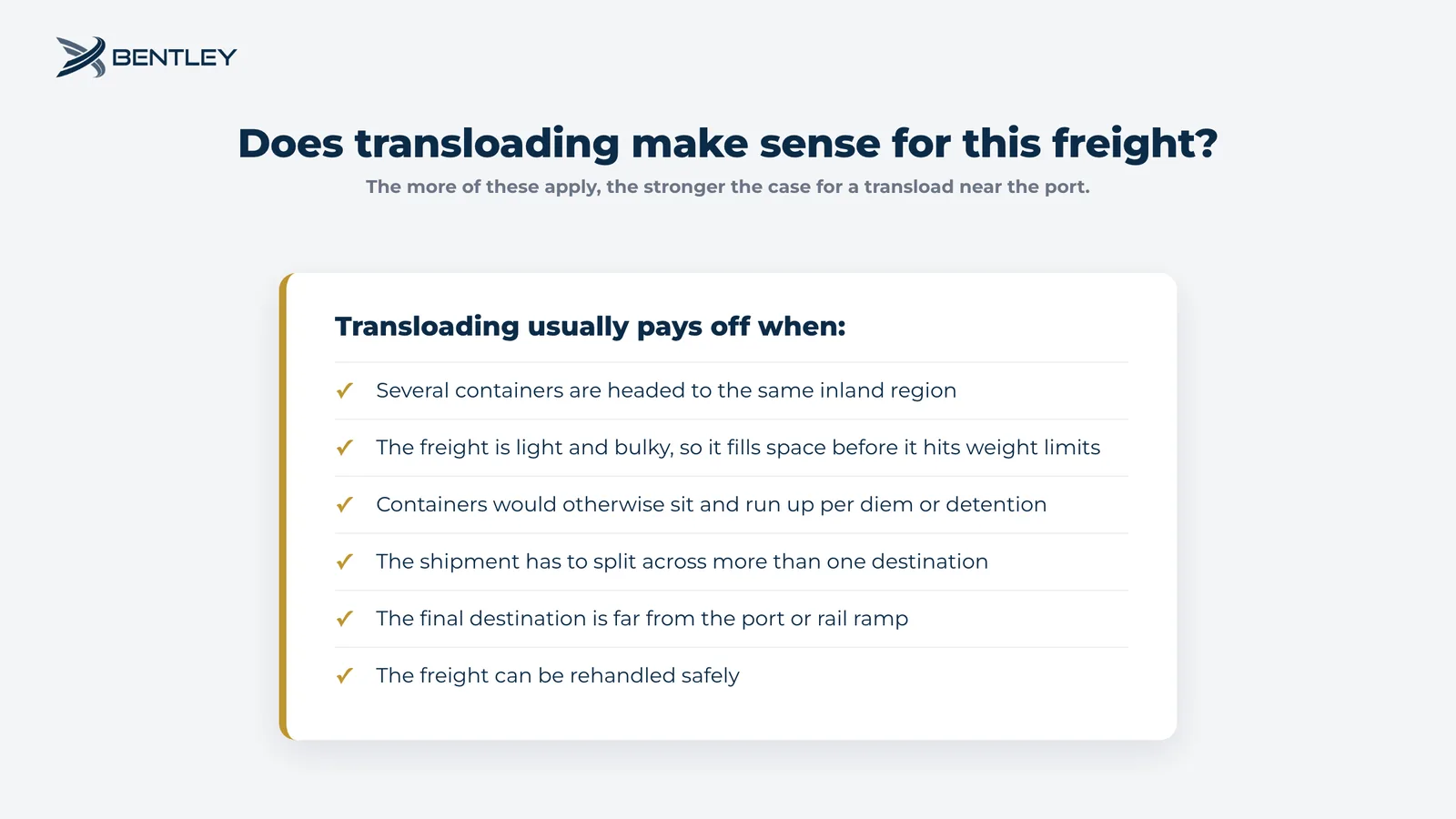
Transloading suits freight that is light for its size, headed to several destinations or a long way inland, and sturdy enough to be handled again. It suits dense, fragile or single-destination freight less well.
Good candidates:
- Palletized or cartoned import freight bound for a region with several receiving sites
- Light, bulky goods that fill a trailer’s space before they reach its weight limit
- Parts and components that will be stored briefly near the port before final orders are known
- Equipment arriving on flat racks or in open top containers that continues on domestic flatbeds
- Freight that needs protective packing, crating or relabeling before its final leg
Weaker candidates:
- Dense freight such as metal parts or bagged materials, which reaches the 80,000 pound federal gross vehicle weight limit for a truck on interstate highways before it fills the trailer
- Fragile or high-value goods where each extra touch raises damage risk more than the move saves
- Shipments with one destination close to the port
- Freight a customer or contract requires to arrive in its original sealed container
Weight is the most common reason a transload fails to save money. A 40-foot container of dense freight can already be at its practical road weight, so moving it into a 53-foot trailer adds handling without taking a single truck off the road.
What are the risks of transloading, and how do you control them?
The main risks are handling damage, lost paperwork, poorly secured outbound loads and fees that keep running because the free-time clock was ignored. Each has a straightforward control.
Document the condition of every load at unload
Photograph the seal, the load face and any damaged pieces before and during unloading, and have the receiver sign the count. A condition record taken at the transload is the evidence that separates ocean damage from inland damage in a claim.
Secure the outbound load for the next mode
Block, brace and strap the outbound load for the transit ahead. Rail legs and long highway runs put more force on cargo than the dray from the port, and a load that rode safely in a tightly packed ocean container can shift once it is rebuilt in a larger trailer.
Track the free-time clock from the day the container is available
Know the free days for demurrage at the terminal and for detention or per diem with the container, and schedule the transload so the empty goes back inside them. Demurrage free time usually starts when the container is discharged and available at the terminal, and detention usually starts when it leaves the gate, so a transload site within a short dray of the port is what makes a same-week return realistic. Late returns erase much of the savings.
Keep the paperwork chain intact
Tie the inbound container number, the packing list and the outbound bills of lading together in one record, with piece counts that reconcile. When freight from one container splits across four trailers, a missing link in that chain is how cartons go missing.
Match the facility’s equipment to the freight
Confirm the transload site has the dock doors, forklift capacity, cranes and floor space the freight needs before booking it. Heavy machinery, flat rack cargo and long parts need different equipment from cartoned consumer goods.
Run this equipment check before booking:
- Dock doors and levelers that fit the container and trailer types involved
- Forklift capacity above the heaviest single piece, with the attachments the freight needs
- Overhead or mobile cranes for machinery and flat rack cargo
- Enough staging floor to sort a full container by destination
- Indoor space for freight that cannot sit outside
When does transloading save money, and when does it add a step for nothing?
Transloading saves money when the container fees and inland moves it removes cost more than the handling it adds. Price both routes side by side before booking.
| Factor | Favors transloading | Favors a direct container move |
|---|---|---|
| Volume | Several containers bound for one region | One or two containers |
| Freight density | Light, bulky freight that fills space first | Dense freight that reaches weight limits first |
| Distance inland | A long haul from the port or rail ramp | A short haul to a site near the port |
| Destinations | Freight splits across several facilities | One destination |
| Container free time | Short free time or high daily fees | Enough free time for the full round trip |
| Handling risk | Freight that tolerates rehandling | Fragile, high-value or sealed freight |
| Timing | Final destination decided after arrival | Destination fixed before arrival |
Price the transload route line by line
Add up the costs that come with the transload:
- The short dray from the terminal to the transload facility
- Handling per container: unloading, sorting, palletizing and reloading
- The outbound domestic trailers or railcars, which should number fewer than the inbound containers
- Any short-term storage and value-added work
Price the direct container route line by line
Add up the costs of keeping the freight in the ocean container:
- The long dray or rail move with the container to each destination
- Chassis days for the full round trip
- Detention or per diem for every day the container is out
- The empty return from the destination to the port or depot
- Demurrage if pickup at the terminal runs late
The route with the lower total wins. For light freight moving several containers at a time to a distant region, the transload usually does. For a single dense container going 40 miles, it usually does not.
How do you choose a transloading provider?
Choose a provider by location, equipment, paperwork discipline and what else it can do with the freight while it is on the dock. Ask these questions before booking:
- How far is the facility from the terminal or rail ramp the containers will use?
- Can it handle the freight profile: floor-loaded cartons, pallets, heavy machinery, flat rack or open top cargo?
- What lifting equipment is on site, and what are its capacities?
- Can it store freight short term if the outbound plan is not ready?
- How does it document condition at unload, and how are damage claims handled?
- Can it block, brace, crate or repack freight for the outbound leg?
- Does it arrange drayage, or does the shipper need to book it separately?
- How are inventory counts tracked and reported across a split shipment?
- Can it handle both directions, import transloads and export container loading, if the business ships both ways?
What transloading support does Bentley World-Packaging provide?
Bentley World-Packaging, the Milwaukee packaging and warehousing firm with a second base in Baltimore, offers transloading as part of its ocean container services: container loading, unloading and trans-loading, drayage arrangements, and blocking and bracing, including open top and flat rack containers, with specialized rigging and heavy lifting.
The work runs out of five facilities with more than 500,000 square feet of space across Milwaukee and Baltimore, including a Baltimore facility at the Shipyard at TradePoint Atlantic. Bentley’s facilities have large drive-in doors and overhead cranes for big and heavy freight.
Freight that needs more than a transfer can stay in the same building:
- Warehousing and inventory control for thousands of part numbers with 99% inventory accuracy, managed in Bentley’s warehouse management system or integrated with the customer’s own (warehousing)
- Export and domestic packing with ISPM-15 certified crating, VCI and moisture barrier protection for cargo that needs it before the next leg (export and domestic packing)
- Kitting, packing and marking for parts that ship onward to customers or plants
One international machinery manufacturer keeps parts inventory at Bentley’s Baltimore facility and ships directly to its customers from there. Bentley reports the company’s on-time KPI improved from 60% to 90% after the move. The same port-side logic is behind most good transload programs, and it is covered in more depth in Bentley’s piece on product distribution centers and the planned article on contract warehousing.
Decide the inland move before the container lands
The cheapest inland move is the one chosen before the vessel arrives, while there is still time to book a transload, line up domestic trailers and plan the empty return. Once the container is on a chassis heading inland, the default move has already been made.
Price the transload route and the direct container route for the next few arrivals, using the tables above, and run the transload on the lanes where it wins.
Have cargo that has to arrive intact and compliant?
Tell Bentley where your containers land, where the freight needs to go and how it is packed, and get a plan for transloading and container services in Milwaukee or Baltimore.