

ASTM D4169 is the standard practice for performance testing of shipping containers and systems. A lab uses it to simulate the hazards of shipping on a packed unit: handling drops, stacking loads, vibration, rail impact and low pressure. The shipper picks a distribution cycle (the route), an assurance level (the severity) and acceptance criteria (what counts as a pass). The lab then runs the matching test schedules in order.
TL;DR
- ASTM D4169 is a lab method that recreates shipping hazards on a packed unit. It has 18 distribution cycles, 10 test schedules (A through J) and 3 assurance levels (I, II and III).
- The shipper makes three decisions: which distribution cycle matches the route, which assurance level matches the risk, and which acceptance criteria define a pass.
- Assurance Level II is the usual starting point. Level I is harsher and Level III is lighter.
- The standard sets the test conditions, and the shipper writes the pass or fail line before testing starts.
- In D4169 the shipper picks the cycle and the level. ISTA procedures follow a fixed protocol for each shipment type.
- A pass proves that one packed design survived one defined simulation. Retest after any change to the product, the pack or the route.
What is in this guide
- What ASTM D4169 is and when a contract or customer asks for it
- The three decisions: distribution cycle, assurance level, acceptance criteria
- The ten test schedules, A through J
- How the sequence runs and how to read a result
- How D4169 compares with ISTA procedures
- When to test, and how to get a package ready for the lab
- FAQs
Most shipping damage starts with a guess. Someone picks a crate, a foam density or a strap pattern based on what worked last time. The first real test is the trip itself. Then a pallet arrives with a crushed corner, a loose machine or a corroded part. The damage claim, the repack and the lost schedule all cost more than the testing would have.
Bentley World-Packaging engineers and tests packaging in Milwaukee, Wisconsin and Baltimore, Maryland, and runs a certified test lab for ASTM D4169. This guide explains the standard for the shipper. It covers what the standard asks you to decide, what the schedules do to your package, and what a passing result tells you.
What is ASTM D4169?
ASTM D4169 is a laboratory practice that evaluates whether a packed shipping unit can survive the distribution environment. It applies a planned sequence of hazards to the unit, such as drops, compression, vibration and impact. The intensities are meant to match real shipping.
ASTM International publishes it under the title “Standard Practice for Performance Testing of Shipping Containers and Systems.” As of this writing, ASTM lists D4169-23e1, released in March 2024, as the active edition. Check the edition your customer or contract names, because the compression sections changed in the 2023 revisions.
Check what the standard covers before you plan a test
The practice applies to many kinds of shipping containers, including boxes, crates, bags and bulk containers, and to the product inside. It works alongside material specifications and existing pre-shipment test procedures. Package design comes first, and D4169 checks the finished design.
Check whether a contract or customer names the standard
Common triggers include a purchase order that requires distribution testing, a medical or regulated product that needs a documented transit simulation, and a customer that rejects shipments after damage. For defense work, read the contract for any test requirement alongside the packaging standard it cites. The MIL-STD-2073-1 overview covers how military packaging requirements are organized, and the MIL-STD-2073 guide explains how a packaging method and level are chosen.
Separate design standards from test standards
ASTM D3951 covers commercial packaging practice, and the breakdown of ASTM D3951-18 explains what it requires. D4169 is a test. A package can follow a design standard and still fail a test. A package can also pass a test and still violate a customer’s design requirement. Plan for both.
Why does distribution testing matter for heavy and sensitive cargo?
The shipping environment applies forces that the packaging team never sees at the packing station. Trucks vibrate for hours. Pallets sit under other pallets in storage. Rail yards deliver sudden longitudinal shocks. Aircraft cargo holds reach low pressure.
Each of those forces damages a package in a different way. Vibration loosens fasteners and wears surfaces where parts rub. Compression crushes corners and bows panels. Impact breaks welds, cracks castings and shifts loads. Low pressure can rupture sealed bags and bladders.
List the hazards your route creates
Write a short route profile before choosing anything else:
- Modes: truck, rail, air, ocean container, or a combination
- Handling: hand loading, forklift, crane, or all three
- Storage: how long the unit sits and how high it is stacked
- Load type: single package, loose load in a trailer, or a unitized pallet load
- Weight and size: the single-package limit that separates parcel-style cycles from freight cycles is 150 lb
This profile drives the first decision in the standard.
Compare the cost of testing with the cost of a failed shipment
Testing a prototype uses a few units. A failed shipment costs the product, the freight, the repack, the claim paperwork and the customer’s patience. Testing moves the failure into the lab, where it costs less and no customer sees it.
Bentley describes its packaging work as engineering protection against moisture, pilferage, vibration and corrosion. Testing validates that engineering. A design tested to a defined cycle and level gives the shipper a documented basis for saying the package fits the route.
How do you choose the right distribution cycle?
Choose the distribution cycle whose description matches how the unit ships. ASTM D4169 lists 18 cycles. They depend on the transport mode and the type of shipment.
Defined term
Distribution cycle
A defined sequence of transport and handling hazards that represents a type of shipment, such as a single package moved by air and truck, or a unitized load moved by rail. ASTM D4169 lists 18 of them.
These cycles are worth knowing by number:
| Cycle | What it represents |
|---|---|
| DC 1 | A general cycle for use when the distribution system is not well defined |
| DC 2 | A user-defined profile, where the shipper picks the schedules and sets the sequence |
| DC 3 | A single package without a pallet or skid, moved by less-than-truckload (LTL) motor freight |
| DC 4 | A single package on a pallet or skid, moved by LTL motor freight |
| DC 13 | A single package up to 150 lb, moved by air for the long leg and by motor freight locally |
The other cycles cover truckload and unitized loads, rail and intermodal moves, warehousing, and container and ship shipments. Read the full description of your cycle in the current edition of the standard. Each cycle lists its own schedules and sequence.
Match the cycle to the longest or harshest leg
Pick the leg of the trip that does the most damage, then check that the cycle covers the rest. A pallet load that travels by truck to a port and then by ocean container is a different case from a single carton on a parcel network. Write the route down and compare it to each cycle’s description line by line.
Use DC 2 when no listed cycle fits
DC 2 covers shipments that mix modes in ways the other cycles leave out. With DC 2 you choose the schedules from the standard and define the sequence yourself. Record your reasoning so a reviewer can follow it. Oversized and heavy equipment often lands here.
Document why the cycle fits
Add one paragraph to the test plan that names the route, the cycle chosen and the reason. When a customer or auditor asks months later why a unit was tested to DC 4, that paragraph is the answer.
What do the assurance levels mean?
Assurance level sets how hard the lab pushes each hazard. Level I is the most severe, Level II is the middle setting and Level III is the lightest. Most shippers choose Level II unless a specific reason points higher or lower.
Defined term
Assurance level
The severity setting applied to the hazards in a cycle. Level I is the most severe, Level II is medium and Level III is the lightest.
| Assurance level | Severity | Typical reason to choose it |
|---|---|---|
| Level I | Highest | Rough routes, high-value or safety-critical cargo, or a very low tolerance for damage |
| Level II | Medium | Standard commercial shipping with ordinary risk |
| Level III | Lowest | A controlled route, a lower-risk product or a justified lighter profile |
Weigh four factors to choose the level
- Value of the product. Higher value supports a higher level.
- Cost of a failure. A damaged unit that stops a production line or a mission costs more than the unit itself.
- Shipment volume. A route run thousands of times a year meets its worst case sooner than a one-off.
- Condition of the route. Multiple handoffs, long stays in storage and unknown carriers all point toward a higher level.
Write the choice into the test plan
State the level and one sentence of justification. A level chosen without a reason looks arbitrary in a review. The next person to run the test also has nothing to compare against.
Pick the level before you see results
Choose the level before testing starts. If you pick it after a failure so the package passes, the level no longer means anything.
What are the ten test schedules in ASTM D4169?
The ten schedules, lettered A through J, each simulate one hazard. A distribution cycle calls for a set of them in a fixed order. This table summarizes what each one represents.
Defined term
Test schedule
One lettered hazard simulation inside the standard, such as manual handling (Schedule A) or random vibration (Schedule E). A distribution cycle calls for a specific set of schedules in a fixed order.
| Schedule | Name | What it simulates |
|---|---|---|
| A | Handling | Manual and mechanical handling, including drops and impacts |
| B | Warehouse stacking | Compressive load from stacking in storage |
| C | Vehicle stacking | Compressive load from stacking in a trailer or container |
| D | Stacked vibration | Vibration while the unit carries a stack |
| E | Vehicle vibration | Random vibration during vehicle transport |
| F | Loose load vibration | Repeated shock and vibration when a unit moves around in a loose load |
| G | Rail switching | Longitudinal shock from rail yard coupling |
| H | Environmental hazard | Temperature and humidity exposure |
| I | Low pressure | Reduced pressure, mainly in air transport |
| J | Concentrated impact | A localized impact on a small area of the pack |
Lab descriptions of the individual schedules differ slightly in how they name the vibration schedules. Use the standard itself to confirm the letter, name and method for each one before writing a test plan.
Read Schedule A for handling drops
Schedule A applies drops and related handling tests. Most shippers think of it first. The drop height and the orientations depend on the weight and size of the unit. The standard points to ASTM D5276 for the free-fall drop test, so the details of how the lab drops a unit come from that method.
Read Schedules B and C for compression
B covers stacking in a warehouse and C covers stacking in a vehicle. The lab applies a load to the top of the unit that represents the weight above it. The load depends on stack height, the number of units above and a safety factor.
Summaries of the 2023 revisions describe changes to how shipping density factors and stack height enter the formula. They also allow a lower safety factor for identical palletized units. Read those sections in the current edition before calculating a load, because a change in stack height or density moves the number the lab applies.
Wood packaging is often tested for compression. Bentley’s certified test lab lists compression testing among its services, along with rotary vibration, incline impact and impact testing.
Read Schedules D, E and F for vibration
D, E and F cover vibration. Stacked vibration applies when the unit carries other units in transit. Vehicle vibration reproduces the random vibration a truck or trailer produces. Loose load vibration reproduces repeated shock when a unit shifts inside a trailer without being secured to a pallet.
Vibration finds problems that a drop test never shows: a fastener that backs out, a component that rubs through its coating, a crate panel that works loose at a joint. It also shows how well the internal blocking and cushioning perform. The securement methods in the container blocking and bracing guide matter most here.
Read Schedule G for rail
Rail switching delivers a longitudinal shock, which is a hard push along the length of the car. If any leg of the route involves rail or an intermodal move, this schedule checks whether the unit holds its position and its structure. The lab simulates the shock with an incline impact test.
Read Schedules H and I for environment
H applies temperature and humidity conditions. I applies low pressure. Low pressure matters for air shipments and for products with sealed volumes such as bags, bladders and some sealed housings. It applies to only some packages, so confirm that it belongs in your plan.
Read Schedule J for concentrated impact
Concentrated impact puts a localized impact on a small area. The standard describes it as most relevant to lightweight single-wall corrugated containers, so it often drops out of plans for heavy wood crates.
How does an ASTM D4169 test run from start to finish?
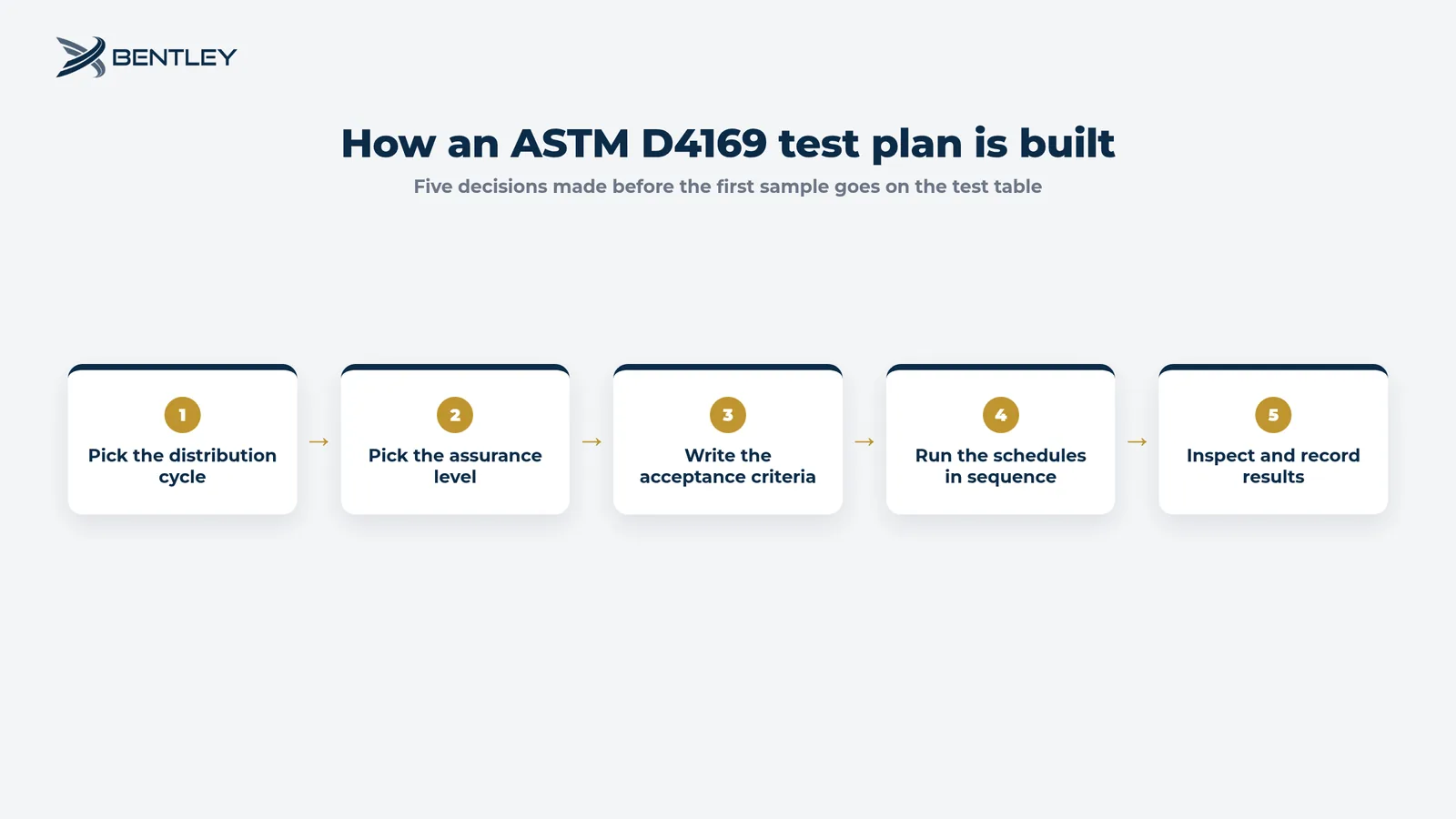
An ASTM D4169 test runs the schedules in the sequence the chosen distribution cycle lists, on the same packed units. The lab inspects the units at the points the test plan names. For performance testing the shipping unit stays closed through the whole sequence.
Write the test plan before the samples arrive
A complete plan includes these items:
- The product, the pack and its drawing or revision number
- The distribution cycle and the reason for it
- The assurance level and the reason for it
- Acceptance criteria, written as observable conditions
- The number of samples
- The standard edition (for example D4169-23e1)
- Conditioning for temperature and humidity if it applies
Prepare samples that match production
Test the pack you will ship. The specimen needs the same dimensions, materials, closures and internal protection as the production unit. A prototype built with different fasteners or a lighter panel proves nothing about the production crate.
Run the sequence in order
The schedules run in the order the cycle specifies, on the same units. Order matters because earlier hazards weaken a package before later ones arrive, as they do in real shipping.
Inspect at the points your plan names
For performance testing, hold the inspection until the sequence ends. That keeps closure behavior in the test. For package development, you can open units between schedules to find out which hazard caused a problem. The cost is losing the closure data.
Record everything
Record the drop heights, the compression loads, the vibration profile and duration, the condition of the units after each step, and photographs. You hand this record to a customer, an auditor or the next engineer.
What are acceptance criteria and who sets them?
Acceptance criteria are the conditions a packed unit must meet after testing, and the shipper or customer sets them. ASTM D4169 sets the test conditions and leaves the pass and fail line to the user, because the right line depends on the product.
Defined term
Acceptance criteria
The written conditions a packed unit must meet after testing, set by the shipper or the customer. The standard leaves them to the user.
A cosmetic scuff may be acceptable on one product and a rejection on another. Each product needs its own criteria.
Write criteria as things an inspector can observe
Good criteria are specific enough that two inspectors reach the same decision. Use this checklist:
- Structure: no cracked panels, no failed joints, no broken skids
- Containment: the product stays in its blocking and stays in position
- Product condition: no damage, no loss of function, defined tolerance on cosmetic marks
- Closure and seals: the unit stays closed and sealed through the sequence
- Moisture and corrosion protection: barriers and inhibitors remain intact
Agree on the criteria with the customer first
Get the customer’s sign-off on the criteria before the test starts. Agreeing afterward turns every borderline result into an argument.
Decide what to do with a partial failure
Write the rule in the plan. A common rule is that any failure of a listed criterion fails the design and triggers a redesign and a retest. If the plan allows a repair and a retest, say how many times.
What does a passing result prove?
A passing result proves that the tested packed design, built the way the test specimens were built, met the acceptance criteria after the chosen cycle at the chosen level. Other configurations, other routes and other levels each need their own evidence.
Three limits apply:
- Tested configuration. A new product weight, a new closure, a different foam density or a change in internal blocking creates a new design that needs its own evidence.
- Simulated route. A route with more handoffs, more stacking or different modes than the chosen cycle sits outside the evidence.
- Chosen level. A Level III pass says less than a Level I pass.
Keep the test report with the design record
Store the report, the drawing revision and the standard edition together. When someone asks whether a change needs retesting, the stored record shows what was tested.
Retest after any change that touches protection
Retest after changes to product weight, center of gravity, packaging materials, closures, internal blocking, the route or the carrier mix.
How does ASTM D4169 compare with ISTA procedures?
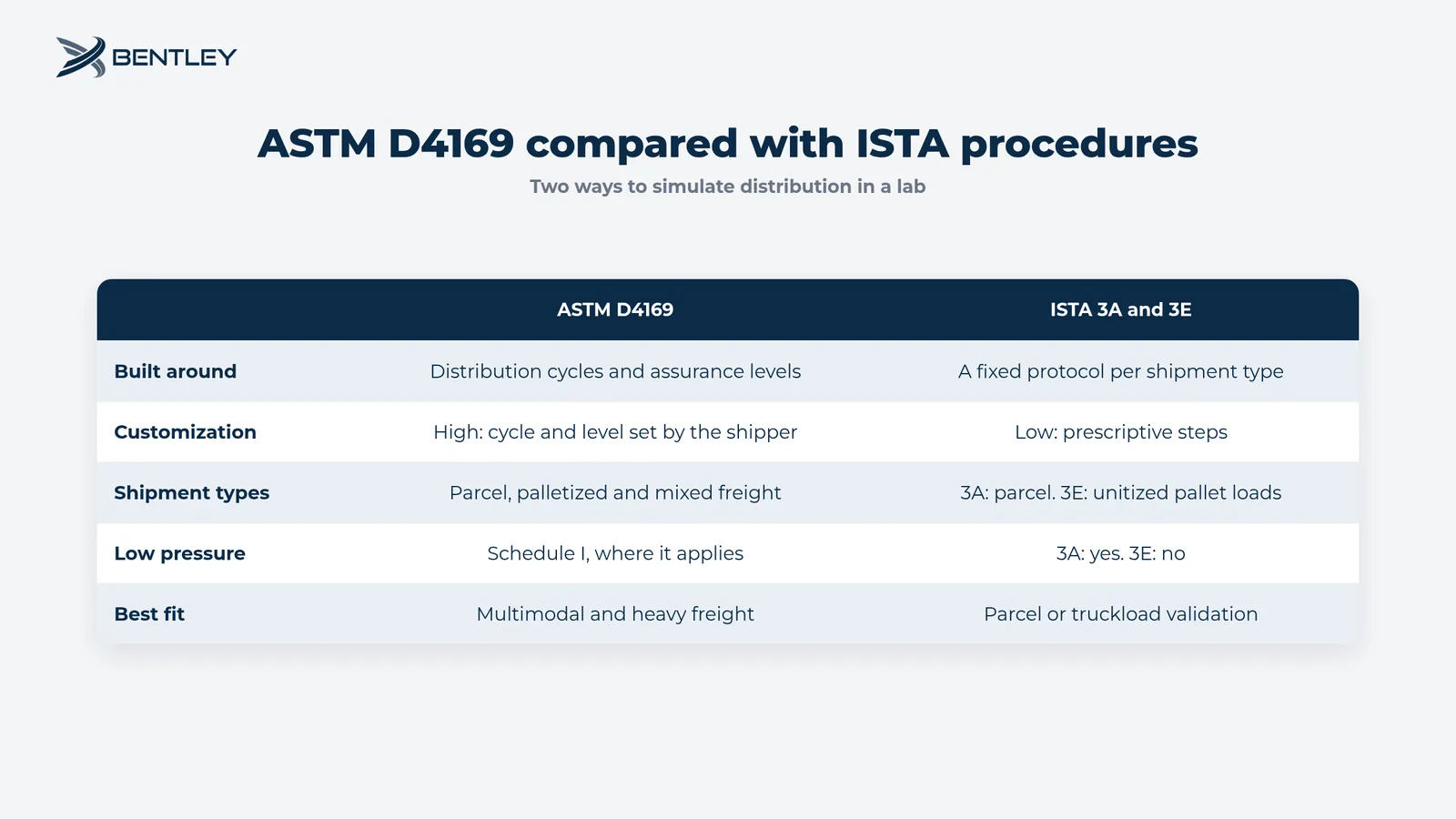
In ASTM D4169 the shipper picks a cycle and a level. ISTA procedures run a fixed protocol for a shipment type, so there are fewer choices and less room to tailor the test.
| ASTM D4169 | ISTA 3A and 3E | |
|---|---|---|
| Structure | Distribution cycles, assurance levels and test schedules | A fixed protocol for each shipment type |
| Customization | High, because the shipper sets the cycle and level | Low, because the steps are prescribed |
| Typical scope | Parcel, palletized and mixed freight across truck, air, rail and sea | 3A covers single-parcel shipments and 3E covers unitized pallet loads in full truckloads |
| Low pressure | Schedule I, where it applies | 3A includes it and 3E leaves it out |
| Best fit | Multimodal, heavy or unusual freight | Parcel or truckload validation with a standard method |
Testing firms disagree on which approach is more severe, and no consensus exists. Sources describe one practical difference: ISTA 3A applies compression and vibration together, and D4169 applies them separately.
Choose D4169 when the route needs tailoring
Choose D4169 when the shipment is heavy, oversized or multimodal, or when a customer names it. The cycle and level structure lets you build a test around the real route.
Choose an ISTA procedure when a customer or carrier names one
Some customers and carriers specify an ISTA procedure. Follow the procedure the customer names. This guide covers ISTA only as a comparison, since Bentley’s certified lab testing is to ASTM D4169.
Use both when a product ships by more than one path
A product that ships by parcel in one channel and by freight in another may need evidence for both. Check the customer’s requirements and the regulatory expectations for the product, and run the test that matches each path.
How do you prepare a heavy or sensitive product for D4169 testing?
Finish the design first, build the production pack, and write the plan and criteria before the lab receives anything. The lab reports on the design as built.
Complete the interior protection before the test
Test the pack with all of its interior protection in place. Common elements include foam and shock-absorbing cushioning, vapor corrosion inhibitors (VCI), moisture barriers and desiccants, and custom blocking, bracing and skids.
Build the crate to the production method
Use the same lumber, panel material, fasteners and assembly method as production. Wood packaging that ships internationally also needs ISPM-15 compliance, and the ISPM-15 guide explains the treatment and stamp. A test unit built from untreated scrap lumber says little about a heat-treated production crate.
Weigh the unit and confirm the center of gravity
The compression load, the drop plan and the vibration response all depend on weight and balance. Record both on the test plan.
Choose the lab and confirm scope
Ask the lab for its accreditation scope, the edition of the standard it works to and the equipment it uses for each schedule. A lab that works alongside the packaging engineers can feed results back into the design quickly.
What does a D4169 test plan look like for a crated machine component?
This example shows how the decisions connect. It is illustrative and describes no real customer.
A manufacturer ships a heavy machine component in a wood crate. The crate goes by truck to a consolidation point, then by LTL motor freight to a customer plant. The crate has integral skids, so no pallet is used.
- Cycle: the route is single-unit LTL motor freight, so the closest listed cycle is the one for a single package or unit moved by LTL. If the crate shipped on a pallet, the cycle for a unit on a pallet or skid would apply.
- Level: the component is expensive and a damaged unit stops a customer’s line, so the team chooses Level I for the first design validation and documents why.
- Criteria: the team writes five observable criteria: no cracked panels, no failed joints, no shift of the component in its blocking, no loosened hardware and no coating wear at contact points.
- Run: the lab runs the schedules the cycle calls for, in order, on the production crate.
- Result: the crate passes handling, compression and vehicle vibration. During vibration the component shows coating wear where it rests on a block.
- Fix: the engineers change the block material and add a protective barrier at the contact point, then retest the revised pack.
The wear finding is the useful result. A drop test would have missed it, and the customer would have found it on arrival.
When should you test?
Test when the cost of a failed shipment exceeds the cost of the test. That covers more cases than most shippers expect:
- A new package design, before production release
- A change to the product’s weight, size or construction
- A change to the packaging materials, closures or internal blocking
- A new route, carrier or transport mode
- A contract or customer that requires distribution testing
- Recurring damage claims on a lane
Treat recurring damage as a test trigger
Recurring damage claims on one lane show what that lane does to your pack. Reproduce the damage in the lab, fix the pack and retest.
Test before you build volume
Testing a prototype run catches design problems before the tooling, lumber and labor for a full run are committed.
Have cargo that has to arrive intact and compliant?
Bentley’s packaging engineers review your current design, review the military standards or industry requirements that apply, and discuss options on quality, durability and cost.
How does Bentley World-Packaging support packaging testing?
Bentley World-Packaging runs a certified test lab that tests in accordance with ASTM D4169, including rotary vibration, incline impact, compression and impact testing. Its packaging engineers design, prototype, test and validate protection in-house. The same company builds the crates and handles kitting, warehousing and distribution from Milwaukee and Baltimore.
The testing and inspection page describes the lab, and the packaging engineering and design page describes how designs are developed. Bentley’s article on how it ensures a valuable product ships safely gives an overview of the process.
Hazardous goods follow a separate certification path. The UN certified packaging guide covers how to read UN codes and specify crates.
Have cargo that has to arrive intact and compliant?
Tell the engineers about the product, the route and the standard your customer names, and ask about ASTM D4169 testing for a new package design.