

UN certified packaging is packaging built to a design type that passed the performance tests in the UN Model Regulations, as adopted in the US by 49 CFR Part 178, and carries the UN specification mark that proves it. The mark tells a hazmat shipper what the packaging is, which packing groups it covers and how much weight it can carry.
TL;DR
- A UN mark is a coded test record: packaging type, packing group rating, weight limit, contents form, year, country and maker.
- Wood boxes carry the codes 4C1, 4C2, 4D and 4F, each limited to 400 kg net mass.
- The X, Y or Z letter has to cover the packing group of the material you ship.
- A design keeps its mark only while every unit is built as tested and retested on schedule.
- Before packing, the shipper checks code, rating, weight, inner packagings and closure instructions against the shipment.
Most UN packaging problems start with a mark nobody on the dock can read. A buyer orders “a UN crate,” it arrives with a stenciled code, and the packer assumes the mark covers whatever goes inside. It may cover a lighter load, a lower packing group or different inner containers. A misread mark is a compliance failure even when the crate itself is well built.
The shipper carries the legal responsibility. Under 49 CFR 173.22, the person offering hazardous material for transport must confirm the packaging is authorized for that material and used the way it was tested. Every rule below comes from 49 CFR Parts 173 and 178; confirm the current revision before relying on any single figure.
Defined Term: UN certified packaging
Packaging made to a design type that passed the drop, stacking and other tests required for its type and contents, and marked as described in 49 CFR 178.503. US regulations call it a UN standard packaging.
Step 1: What does each part of a UN packaging code mean?
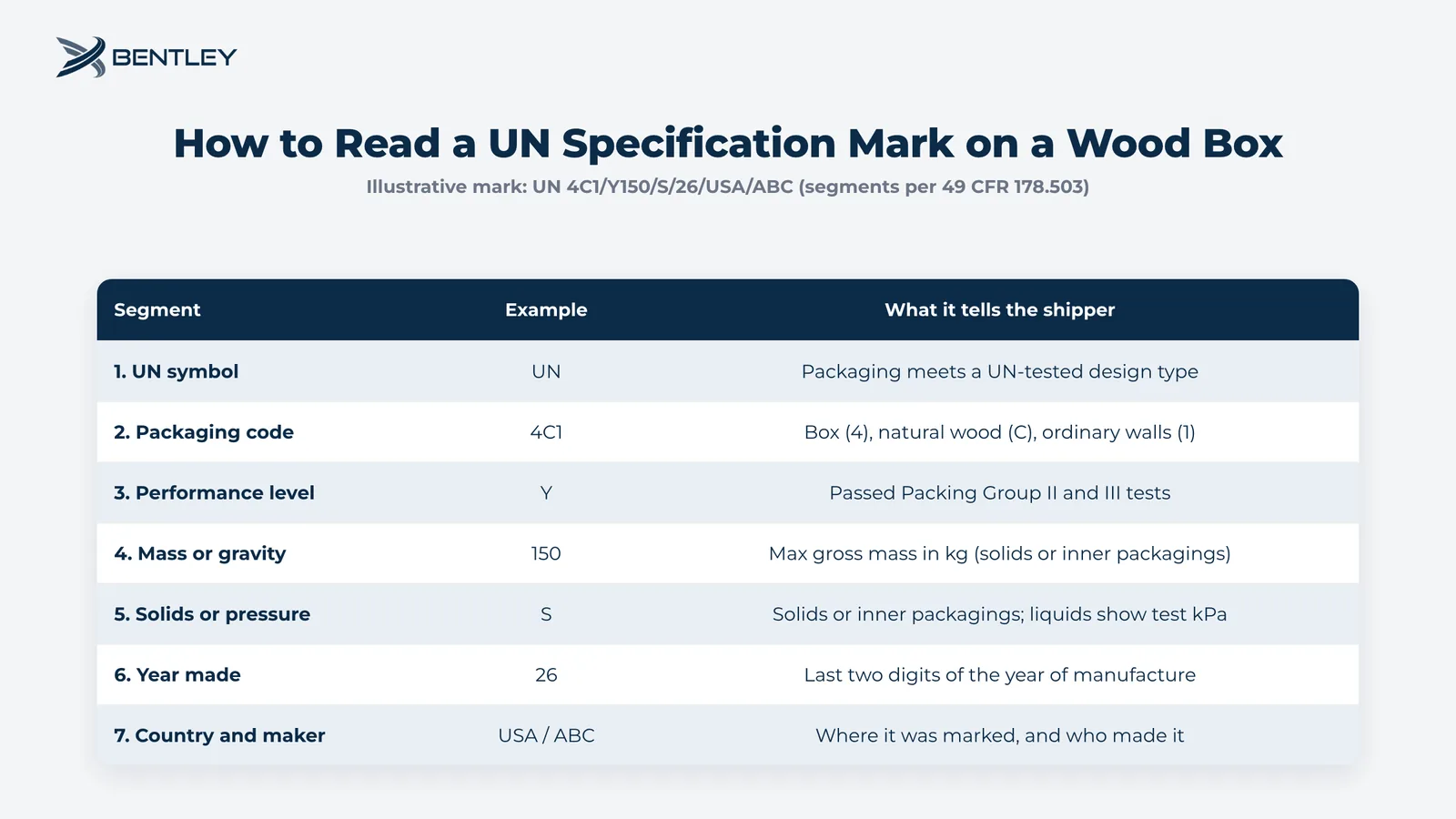
A UN specification mark is a fixed sequence of segments, each answering one question about the packaging. An illustrative mark on a wood box for solids reads UN 4C1/Y150/S/26/USA/ABC.
| Segment | Example | What it tells you |
|---|---|---|
| UN symbol | UN in a circle | The packaging meets a UN-tested design type |
| Packaging identification code | 4C1 | Kind of packaging, material and category |
| Performance level | Y | The packing groups the design passed tests for |
| Mass or specific gravity | 150 | Maximum gross mass in kg for solids or inner packagings |
| Solids or test pressure | S | S for solids or inner packagings; a kPa figure for liquids |
| Year of manufacture | 26 | Last two digits of the year made |
| Country and manufacturer | USA / ABC | Marked under US rules; maker’s name or registered symbol |
Decode the packaging identification code
The code has up to three parts, set out in 49 CFR 178.502:
- A numeral for the kind of packaging. 1 is a drum, 2 a wooden barrel, 3 a jerrican, 4 a box, 5 a bag, 6 a composite and 7 a pressure receptacle.
- A letter for the material. A is steel, B aluminum, C natural wood, D plywood, F reconstituted wood, G fiberboard and H plastic, among others.
- A numeral for the category. For wood boxes, 4C1 is an ordinary box and 4C2 has sift-proof walls.
A combination packaging carries only the code of its outer packaging, so a wood box holding glass bottles is marked 4C1 or 4C2. A V after the code means the box was tested under the selective testing variation in 49 CFR 178.601(g)(2). A W means it carries a regulator approval in place of the standard tests.
Read the performance letter
The letter after the slash states which packing groups the design was tested for:
- X covers Packing Groups I, II and III.
- Y covers Packing Groups II and III.
- Z covers Packing Group III only.
A design rated X can carry Packing Group III material. A design rated Z cannot carry Packing Group II material, no matter how sturdy the crate looks.
Check the weight and contents segments
For solids and inner packagings, the number after the performance letter is the maximum gross mass in kilograms: box, inner packagings, cushioning and contents together. A box marked Y150 that leaves the dock at 165 kg is outside its rating, so weigh the packed crate.
An S means solids or inner packagings, which is what wood boxes almost always show. A number in that position is a hydrostatic test pressure in kPa and applies only to packagings for liquids.
Check the mark itself
Under 49 CFR 178.3, characters must be at least 12 mm high on packagings over 30 kg or 30 L, and at least 6 mm at or below those limits. The mark goes on a non-removable part in an unobstructed area, and packages over 30 kg gross carry it on the top or a side. It must be stamped, burned, printed or otherwise applied so it stays legible.
Step 2: Which UN codes apply to wood boxes and crates?
Four codes cover non-bulk wood boxes, and all share a 400 kg (882 lb) maximum net mass under 49 CFR 178.513 through 178.515.
| Code | Material | Construction rule |
|---|---|---|
| 4C1 | Natural wood, ordinary | Seasoned, commercially dry wood free of strength-reducing defects; vibration-resistant fastenings |
| 4C2 | Natural wood, sift-proof | Same as 4C1, plus one-piece parts or approved glued joints |
| 4D | Plywood | At least three plies glued with water-resistant adhesive |
| 4F | Reconstituted wood | Water-resistant hardboard, particle board or similar walls |
Defined Term: Sift-proof
Built so dry contents, including fine particles produced in transport, cannot escape. A 4C2 box gets there with one-piece parts or approved joints such as tongue-and-groove, ship lap, rabbet, or butt joints with at least two corrugated metal fasteners each.
Match the box to the contents
Powders, granules and solids that break down into dust need sift-proof 4C2 walls. Most hazmat in wood boxes ships as a combination packaging, with the material in tested inner containers and a 4C1 box as the outer packaging. The mark describes that tested combination, so inner containers, cushioning and closures must match the test report.
Know when a crate leaves the box category
Loads above 400 kg move into other UN categories with their own codes and tests: wood intermediate bulk containers (11C, 11D, 11F) and large packagings (50C for natural wood). If a hazmat item outgrows a box, ask your supplier which of those design types fits.
Add ISPM-15 for export
Solid wood packaging in international trade generally has to meet ISPM-15, the pest-treatment standard. It is a separate rule from the UN mark, so a solid lumber 4C1 export crate needs both. Plywood and reconstituted wood are processed materials and typically fall outside ISPM-15.
Step 3: How do you match the packing group to the X, Y or Z rating?
Find the packing group in the hazardous materials table entry for your material, then confirm the performance letter on the packaging covers it.
Defined Term: Packing group
A ranking assigned to most hazardous materials by degree of danger. Packing Group I is great danger, II is medium danger and III is minor danger.
| Packing group | Ratings that can carry it | Drop height for solids |
|---|---|---|
| I (great danger) | X only | 1.8 m (5.9 ft) |
| II (medium danger) | X or Y | 1.2 m (3.9 ft) |
| III (minor danger) | X, Y or Z | 0.8 m (2.6 ft) |
The drop heights come from 49 CFR 178.603(e). A Z-rated crate was only proven at 0.8 m, which is why it cannot carry Packing Group II material.
Pull the packing group from the shipping papers
Start with the UN number and proper shipping name. The hazardous materials table in 49 CFR 172.101 gives the hazard class, the packing group and the section of 49 CFR 173 that lists authorized packagings. Only then does the mark on the crate become useful.
Confirm the code is on the authorized list
A packaging can carry the right performance letter and still be the wrong packaging type. If the authorized packaging section for your material does not list wood boxes, a perfect 4C1/X mark does not help. Confirm both the code and the letter before you order.
Use one rating across a varied product list
Programs that ship several hazmat items in one design often specify the highest packing group on the list. An X-rated design costs more to qualify, and it keeps one crate in service when the product mix changes.
Step 4: How does a wood crate design earn a UN mark?
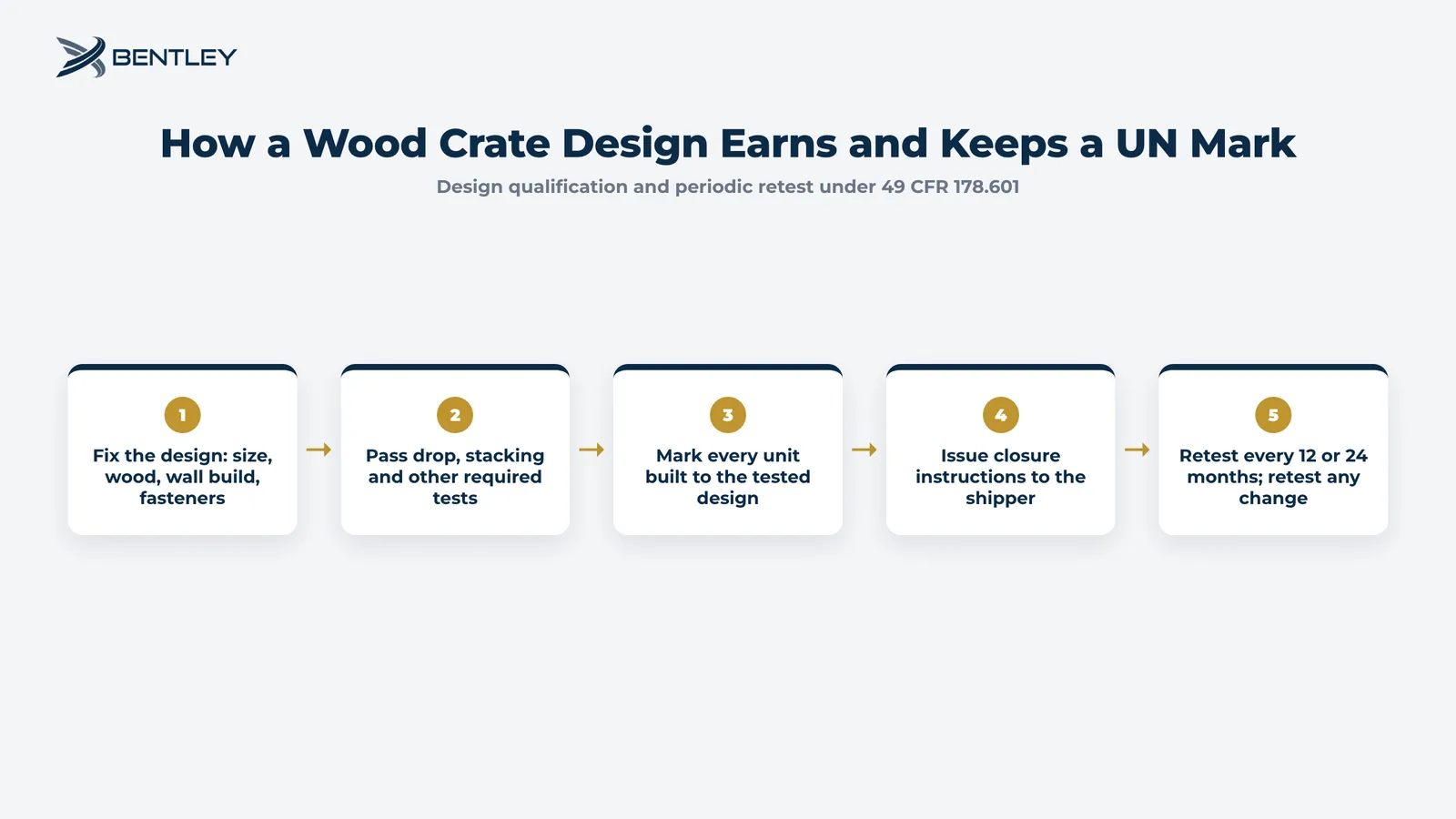
A crate design earns the mark by passing design qualification testing at the start of production under 49 CFR 178.601(d). Samples are built exactly like production units, filled with the intended contents or an equivalent, and run through the tests for that packaging type.
Pass the drop and stacking tests
For boxes, 49 CFR 178.603 calls for five samples, each dropped once: flat on the bottom, top, long side and short side, and on a corner. Inner packagings must stay inside with no leakage. Under 49 CFR 178.606, three samples then carry the weight of a 3 m (10 ft) stack of identical packages for 24 hours with no leakage or weakening distortion. Liquids add leakproofness and hydrostatic tests, and the vibration standard in 178.608 also applies to non-bulk packagings.
Keep records and retest on schedule
Under 49 CFR 178.601(l), the manufacturer keeps records for as long as the packaging is made plus two years, and design test reports for six years (single and composite) or seven years (combination). The report names the test facility, design type, maximum capacity, test contents and results, and must be available to the packaging user or DOT on request. Periodic retests run at least every 12 months for single and composite packagings and every 24 months for combination packagings, which covers most hazmat wood boxes.
Issue closure instructions
Under 49 CFR 178.2(c), the certifier and each distributor must tell the next party which requirements were not met at transfer and how to close the packaging so it performs as tested. The method must be consistent and repeatable, and the sender keeps a copy for at least one year.
Have cargo that has to arrive intact and compliant?
Bentley World-Packaging builds U.N.-approved crates for hazardous goods. Send the material list and shipment details to start the specification.
Step 5: What changes void a UN packaging certification?
Any change that makes a packaging different from the tested design takes it outside the mark. Under 49 CFR 178.601(c)(4), that means a change in any of five areas:
- Structural design: adding an untested door panel or internal divider.
- Size: lengthening the box to fit a longer inner container.
- Material: swapping solid lumber panels for plywood, which also changes the code.
- Wall thickness: moving to thinner boards to cut weight.
- Manner of construction: changing nails to staples or changing the joint type.
Control drift on the shop floor
These changes rarely come from engineering decisions. They come from a lumber delivery at a different thickness, an out-of-stock fastener, or a builder adding a cleat that “can only help.” Keep a controlled build sheet for each UN design listing material, dimensions, fasteners and joints, and require sign-off before any substitution.
Use the permitted variations deliberately
49 CFR 178.601(g) allows some variation without new tests. A tested combination can use similar or smaller inner packagings with enough cushioning (Variation 1), and its outer box can shrink if every external dimension stays at or under the tested design (Variation 4). Variation 2 allows articles or inner packagings in a tested outer box under strict conditions, with a V added to the mark. Surface treatment changes and a lower design height also fall outside the definition of a different packaging. Anything else needs new testing or a regulator approval.
Retire marks you cannot defend
If a design has drifted and the test report no longer matches what the shop builds, stop marking new units until the design is retested. A crate with a mark it cannot back up is a larger liability than an unmarked crate, because it invites a shipper to rely on it.
Step 6: What should a shipper check before packing a UN crate?
The shipper checks the packaging against the shipment every time, because 49 CFR 173.22 puts the responsibility on the person offering the material.
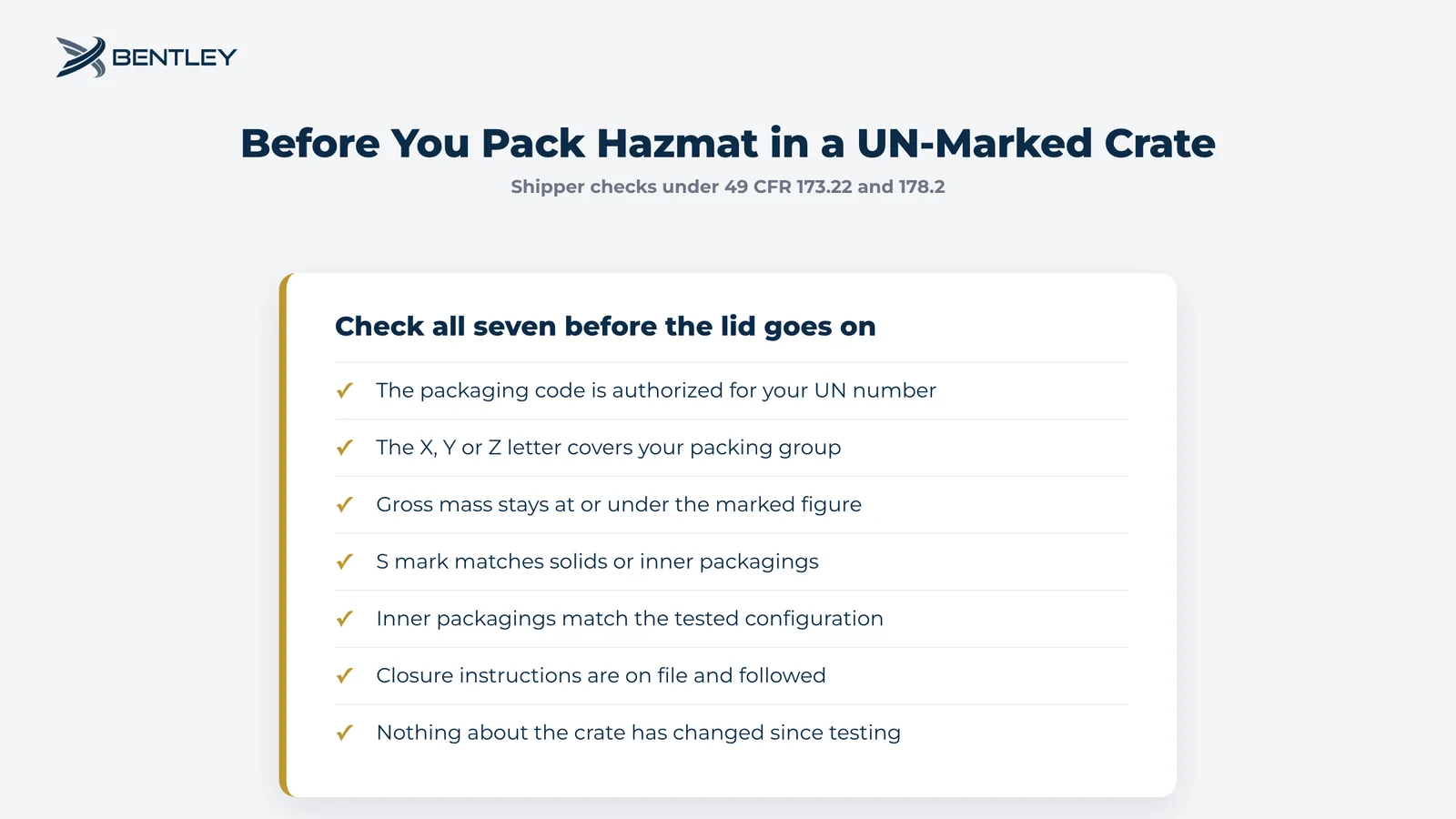
Run the seven-point check
- The packaging code is authorized for your UN number.
- The performance letter covers the packing group.
- Packed gross mass is at or under the marked figure.
- The S segment matches solids or inner packagings.
- Inner packagings match the tested configuration or a permitted variation.
- Closure instructions are on file and followed.
- The crate matches the tested design, with no added parts or substitutions.
Keep the evidence with the shipment file
Hold a copy of the closure instructions, the manufacturer’s notification and the packing record for each shipment. If an inspector or carrier questions the package, the file shows it was authorized and closed as tested.
Check the other modes before booking
The mark is international, but each mode adds rules. Ocean shipments also follow the IMDG Code, and air shipments follow the ICAO Technical Instructions or the IATA Dangerous Goods Regulations, which can restrict quantities or packaging types further. A crate that is legal for highway transport may still need changes for air.
Step 7: How do you specify a UN crate to a packaging supplier?
Give the supplier the material data, inner packaging details and transport route, and let the design follow. A request that says only “hazmat crate, 48 x 40 x 36” cannot be quoted accurately. Lead with the safety data sheet and the shipping description, and send:
| Information to send | Why the supplier needs it |
|---|---|
| UN number and proper shipping name | Sets the hazard class, packing group and authorized packaging list |
| Hazard class and packing group | Sets the performance letter the design has to earn |
| Physical form (solid, liquid, article) | Decides S versus test pressure and which tests apply |
| Inner packagings: type, size, count, closures | Defines the combination that gets tested and marked |
| Gross weight and dimensions of the contents | Sets the mass rating and whether the load fits a box or needs a large packaging |
| Modes and destination countries | Adds IMDG, air and ISPM-15 requirements |
| Annual volume and reorder pattern | Shapes how the design is built, documented and retested |
Ask up front what comes with each order: the mark, closure instructions, the 178.2(c) notification and access to the test reports. For repeat programs, ask how the supplier controls material and fastener substitutions between runs.
Where does Bentley World-Packaging fit in UN crate work?
Bentley World-Packaging builds U.N.-approved crates for hazardous goods as part of its specialty wood packaging work, alongside crate designs for ocean containers, heavy duty skids and custom crates for heavy, sensitive and oversized products. The UN design type, rating and documentation for a program are set when the material list and shipment details are reviewed.
Bentley handles the supporting work under one roof:
- Packaging engineering and design using CAD and structural load analysis, with prototypes tested and validated in-house.
- ISPM-15 certified and stamped wood packaging for export crates.
- A certified test lab for ASTM D4169 distribution testing, including rotary vibration, incline impact, compression and impact testing.
- Export and domestic packing, plus ocean container services such as loading, blocking and bracing.
For crate construction choices, see the Understanding Wooden Shipping Crates guide and The Importance of ISPM 15 Compliance. Bentley’s specialty wood packaging, testing and inspection and export and domestic packing pages list the related services.
What is the bottom line on UN certified packaging?
A UN mark is a coded test record, and every segment limits what the packaging can carry. Check the code against the authorized list, match the letter to the packing group, stay under the marked weight, and build every unit exactly as tested.
Have cargo that has to arrive intact and compliant?
Send the UN numbers, packing groups and inner packaging details for your shipment, and Bentley’s packaging engineers will review the crate requirements with you.
About Bentley World-Packaging
Bentley World-Packaging is an industrial, export and military packaging company headquartered in Milwaukee, Wisconsin, with facilities in Baltimore, Maryland. It engineers, builds and tests custom wood crates, handles export and military packing, and runs warehousing and distribution from five facilities with over 500,000 square feet.
Related reading
- Container Blocking and Bracing: How to Secure Heavy Cargo for Ocean Shipping
- Understanding Wooden Shipping Crates: Bentley’s Guide to Durable, Custom Packaging
- Export Packing Solutions: Bentley’s Guide to Global Shipment Success